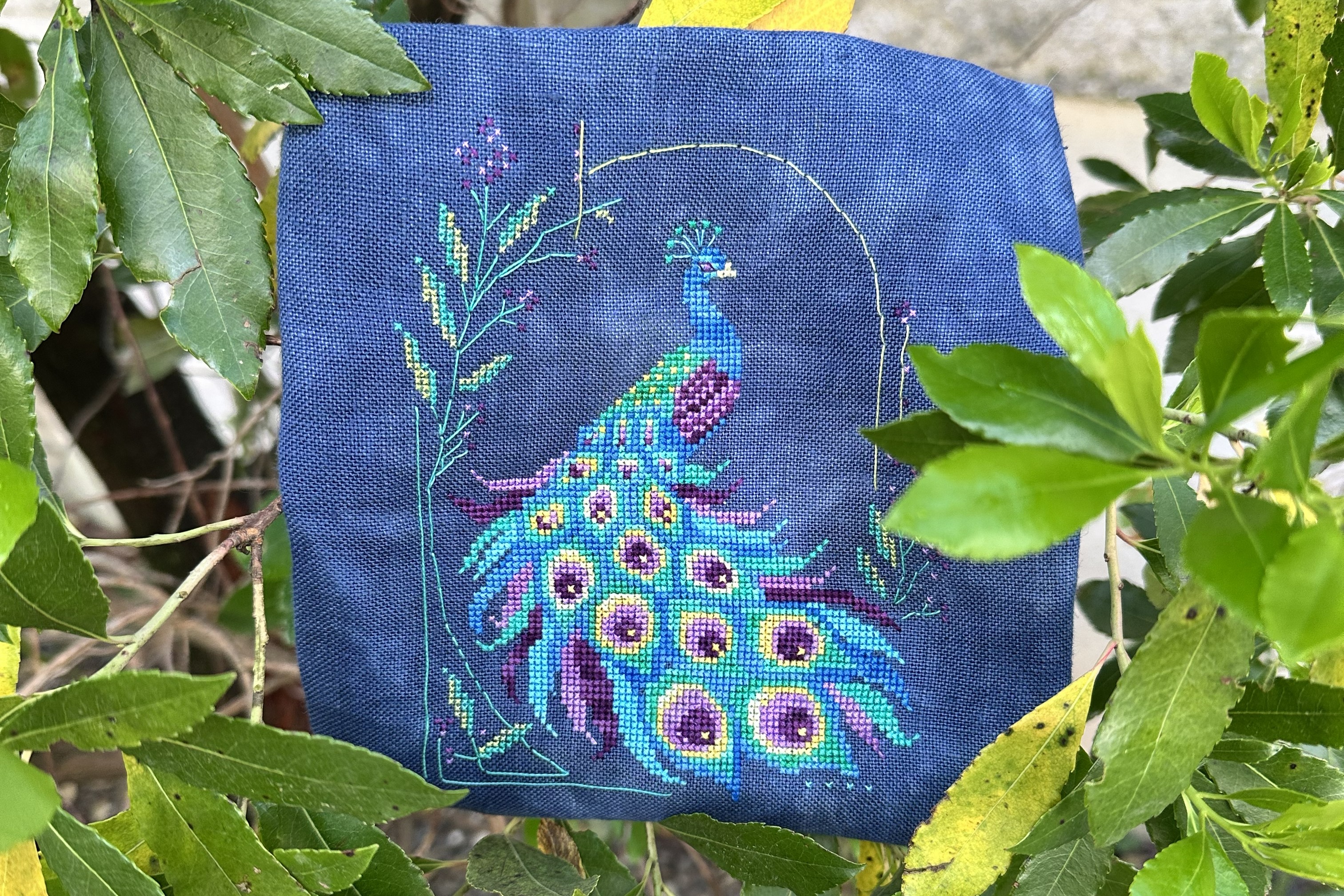
The Peacock: Glamour, Symbolism and Why We Can’t Stop Stitching Them
By Melanie & Dominique
There are some subjects in embroidery that just make sense. Florals, obviously. Landscapes, sure.
But the peacock? The peacock is in a category entirely of its own. Dramatic, breathtakingly beautiful and absolutely aware of it, honestly, if the peacock could stitch, it would only ever work on itself.
But there’s far more to this bird than showing off. Peacocks have been woven into human culture, mythology and symbolism for thousands of years, and once you start looking, it’s hard not to see why they keep turning up on our fabric too.
A bird with serious history
In ancient Greek mythology, the peacock was sacred to Hera, queen of the gods. Those extraordinary “eyes” on the tail feathers? Said to represent the hundred-eyed giant Argus, placed there by Hera herself. Watching over everything. Rather like the feeling of having seventeen WIPs on the go and none of them finished.
In Hinduism, the peacock is the mount of Saraswati, goddess of wisdom, art and learning, which feels very fitting for a creature that turns up so often in the hands of makers and artists. In Persian and Babylonian culture, two peacocks flanking the Tree of Life became one of the most enduring motifs in decorative art, and you’ll still find it today in everything from antique textiles to modern cross-stitch charts.
Christianity adopted the peacock too, as a symbol of immortality and resurrection, the idea being that peacock flesh was believed (incorrectly, one assumes) to be incorruptible. The “eyes” on the feathers were also seen as representing the all-seeing eye of God.
What the peacock represents
Across cultures, the peacock tends to show up as a symbol of the same qualities, give or take a few centuries and a mythology or two.
Beauty and confidence, not vanity exactly, but the kind of unapologetic self-expression that comes from knowing your worth. Something we could all take a leaf out of, frankly.
Renewal and immortality, peacocks shed and regrow their magnificent tail feathers every year. There’s something quietly hopeful about that.
Vision and wisdom, those extraordinary eyes aren’t just decorative. They’ve long been associated with the ability to see clearly, to perceive what others miss.
Protection, in many traditions, those eye markings were believed to ward off evil. Essentially, the original evil eye charm, just with significantly better plumage.
A muse across centuries
Long before anyone picked up a cross-stitch needle, the peacock had already conquered the decorative arts entirely. It appeared in Roman floor mosaics, Byzantine religious paintings, and Persian manuscript illustrations. The Mughal courts of India were particularly obsessed with peacock motifs, which ran through everything from architecture to jewellery to the most exquisite embroidered textiles imaginable.
The Ottoman Empire was equally smitten. Peacock feather patterns became a staple of the court textiles and tilework, with a distinctive eye shape appearing on silks and velvets destined for the most powerful people in the world.
Then came the Victorian era and the Aesthetic Movement, which basically said “more peacocks, please” and meant it. Artists like James McNeill Whistler and designers associated with the Arts and Crafts movement embraced the peacock as the ultimate symbol of beauty for beauty’s sake. William Morris, whose influence on embroidery design we still feel today, used peacock imagery repeatedly. Art Nouveau took it even further; those sinuous tail feathers were practically made for the flowing lines of that style.
Why do we stitch them?
Honestly? Because they’re glorious to stitch.
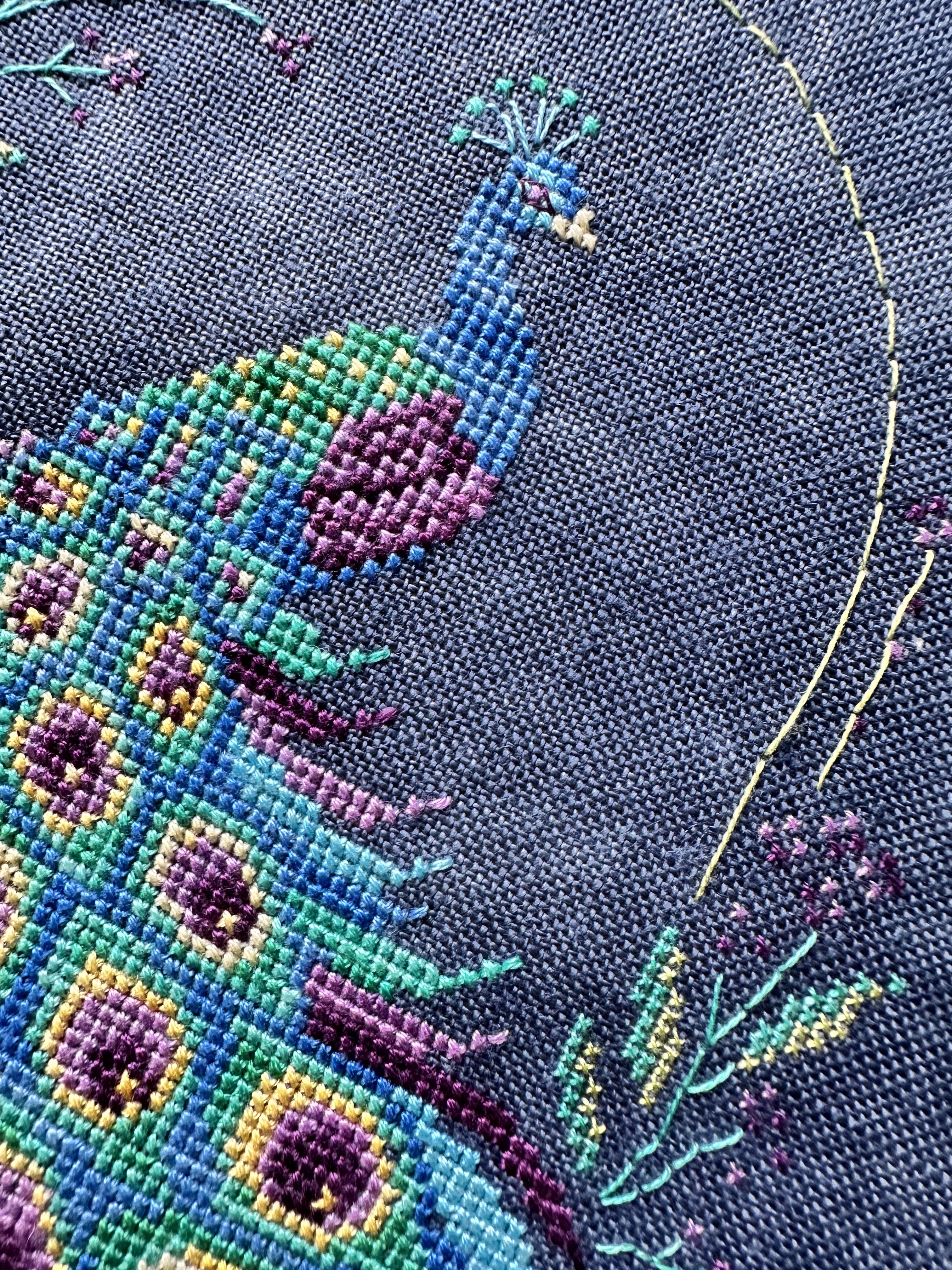
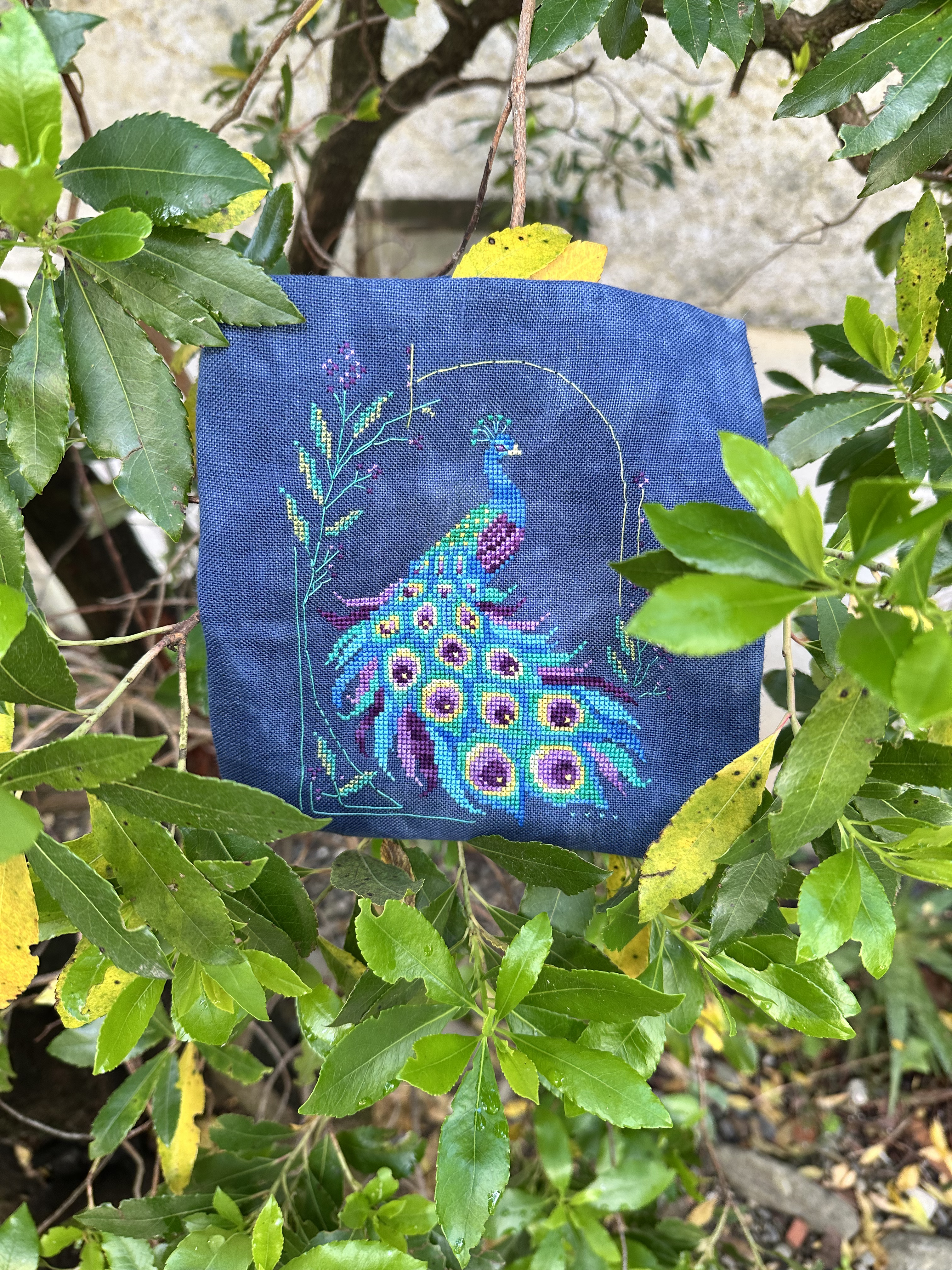
The tail feathers alone are a playground, all that gradation, those iridescent blues and greens shifting into gold, the perfect circular symmetry of each eye. If we’re working with hand-dyed threads, a peacock is basically an excuse to use every beautiful colour in our stash and call it research.
They reward skill. The more detail we put in, the more magnificent the result. They’re also wonderfully forgiving in terms of colour interpretation. We can go traditional teal and gold, we can go completely wild with hand-dyed pinks and purples, and it still works. The peacock is unbothered. The peacock contains multitudes.
Peacock motifs have appeared in embroidery traditions across the world for centuries, from Indian zardozi goldwork to Victorian Berlin woolwork, from Ottoman court embroidery to Art Nouveau textile design. There’s barely a needlework tradition on earth that hasn’t had a go at the peacock at some point. We’re just continuing a very long and very distinguished tradition.
With a hoop in our hands and probably a cold cup of tea beside us.
A final thought
Thousands of years of humans looking at this bird and thinking, yes, that needs to be immortalised in art. The peacock has earned its place as a symbol of beauty, vision and renewal across almost every culture that has ever encountered it.
Which makes it basically the perfect subject for a cross-stitch project. Obviously.
Have you ever stitched a peacock? We’d love to know
Melanie & Dominique x


